
Written by: Cameron Purvis
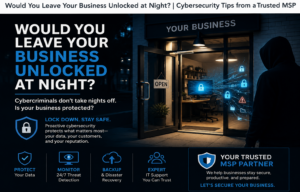
Would You Leave Your Business Unlocked Overnight?
Imagine closing your business at the end of the day. Before heading home, you turn off the lights, lock the doors, set the alarm, and check that your security cameras are active. Now imagine doing none of those things. You leave the front door unlocked, disable the cameras, and walk away, hoping nobody notices. Most business owners would never take that risk. Yet every day, companies do the digital equivalent by relying solely on basic antivirus software and assuming they’re protected from cyber threats. The reality is that cybersecurity and physical security have a lot in common. Both are designed to protect your assets, your operations, and your reputation. And just as you wouldn’t trust a single lock to protect your entire building, you shouldn’t depend on antivirus alone to protect your business. When you lock your business up at night, you’re creating the first barrier between your business and potential criminals. The lock isn’t perfect, but it does stop some opportunistic thieves from breaking in.
In cybersecurity, firewalls, strong passwords, multi-factor authentication, and secure access controls serve the same purpose. They create barriers that make it more difficult for attackers to gain entry into your systems. Unfortunately, many businesses still have weak passwords, shared accounts, or outdated systems. It’s the digital equivalent of leaving a key under the doormat. Cybercriminals know exactly where to look, and automated attacks are constantly scanning businesses for these easy opportunities. A locked door is essential, but it’s only the beginning. In all of my years in IT I’d say easily 2 out of 3 business owners downplay the importance of cyber security. I hear responses like “we’re good”, “we’ve got a guy that handles that for us”, “we’re a small business we really don’t have much need for cyber security”. For whatever reason telling a business owner that they likely have multiple cyber security breaches and everything down to their amazon password has been breached or is for sale on the dark web doesn’t hit the same as you’re locks on your doors to your building don’t work. But if you think about it even if a thief breaks into your building and steals computers, TV’s, laptops, your favorite Bose headphones, and maybe your favorite painting off the wall it all falls short in comparison to what your company will lose if you have a bad cyber security breach. One thing I always try to convey to clients is that the hackers out there aren’t really there for your, as in your companies’ data typically, they’re there for your customers data. If your company handles things for a few hundred different clients, do you think a hacker would want that or just your company’s information? I can’t tell you how many times I’ve had clients shrug off the cyber security monitoring portion of my company’s IT management package and then they have a breach and not only lose money, but they also lose their reputation to their clients and that unfortunately is impossible in many cases to get back. Once trust is broken when it comes to cyber breaches most clients decide to move on and or spread the word that your company can’t protect their client’s sensitive information.
Security Cameras: Knowing What’s Happening
Most businesses install security cameras because they understand an important principle: you can’t respond to a problem you can’t see. Security cameras allow you to monitor activity, identify suspicious behavior, and review events after an incident occurs. They provide visibility and accountability. Cybersecurity requires the same level of awareness. Modern security monitoring tools continuously watch your network, devices, and user activity for signs of unusual behavior. They can detect suspicious login attempts, unauthorized access, malware activity, and other indicators that something isn’t right. Without visibility into your environment, cyber threats can go unnoticed for weeks or even months. The average amount of time that a business takes to find out about a breach is 365 days. With my MSP, the average response time to a breach is 15 minutes. Speed matters. In both physical security and cybersecurity, the longer an intruder remains undetected, the more damage they can cause. A burglar who spends five minutes inside your building is a problem. A burglar who spends eight hours inside your building can be devastating. The same is true with cyberattacks. The sooner threats are detected and addressed, the more likely your organization can minimize disruption, reduce financial losses, and protect sensitive information. Imagine arriving at your business one morning to discover someone has been entering your building every night for the past six months, taking information and valuables while you remain completely unaware. As unbelievable as that sounds, similar situations happen in cybersecurity every day. Many companies don’t discover they’ve been compromised until customer information has been stolen, operations have been disrupted, or ransomware has encrypted critical systems. You can’t protect what you can’t see.
Why Antivirus Alone Isn’t Enough
Now I hate to age myself, but I am in my 40’s and for years antivirus software was considered the primary solution for cybersecurity. It played an important role by identifying known malicious files and preventing certain types of malware infections. But the threat landscape has changed dramatically. Today’s cybercriminals are more sophisticated, organized, and persistent than ever before. Many modern attacks don’t rely on traditional viruses at all. We’ve all seen the movies where the hacker inserts a “Trojan Horse” virus that enters through some back door in the system, well those days are long gone. These days attackers exploit weak passwords, compromise email accounts, abuse legitimate software tools, and use social engineering tactics to gain access to systems. Some attacks are specifically designed to avoid detection by traditional antivirus programs. Relying on antivirus alone is similar to securing your business with only a front door lock. What happens if someone enters through a window? What if an employee accidentally lets someone inside? What if suspicious activity occurs after hours and no one is watching?
You wouldn’t depend on a single lock to protect your building. You would implement multiple layers of protection, including locks, cameras, alarms, and procedures designed to work together. Cybersecurity should follow the same strategy. Effective cybersecurity isn’t one product or one piece of software. It’s a comprehensive approach that combines preventive measures, continuous monitoring, employee education, and rapid response capabilities. It’s important to know the plan when there is a breach, to know what your response time is, and to have more people than one in the building that know about that plan. At CEG, we help organizations identify vulnerabilities and strengthen their security posture through strategic cybersecurity consulting and managed security services. We’ll give your company a road map to success and how to avoid leaving your company’s sensitive information vulnerable. We offer a complimentary commitment free consultation that comes with a complimentary security scan of your network to all potential new clients. If you’re interested in free consultation, then just click the link below and we’ll get your company started on the road to peace of mind regarding your cyber security for your company.
Free Consultation https://www.cegsupport.com/free-consultation/